
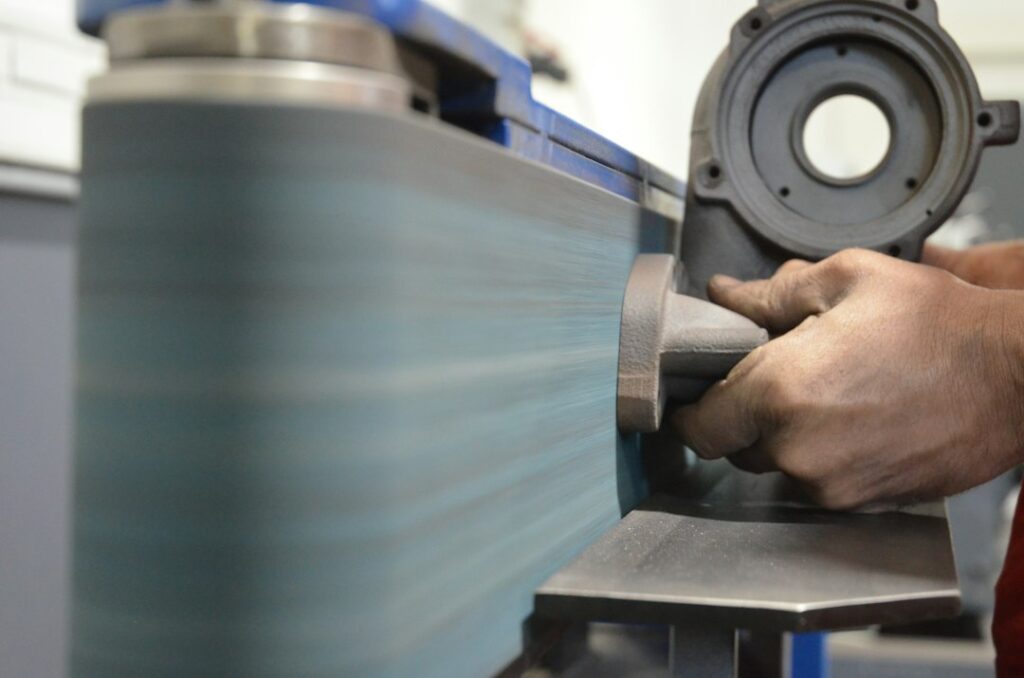
The as-cast condition
A cast aluminum part straight out of the mold shows parting lines, possible flash, a surface texture typical of the process and, in some cases, minor surface defects that should be assessed before choosing the final finish.
Not every part needs the same level of finishing: parts hidden inside an assembly may need only deburring, while visible parts or parts with functional contact require additional processes.
Precision machining after casting
Surfaces that need tight dimensional tolerance, flatness or a fit with other components almost always require machining after casting, since casting alone does not reach those tolerances consistently.
Machining also removes minor surface defects in critical areas and creates reliable dimensional datums for assembly.
Shot blasting and surface cleaning
Blasting with sand, glass bead or metallic media cleans the surface, evens out its texture and prepares the part for later processes such as painting or anodizing, improving coating adhesion.
It can also be used as a final finish on parts that need a uniform matte appearance without an additional coating, which lowers the cost of the overall process.
Anodizing and surface protection
Anodizing creates a controlled oxide layer that improves resistance to corrosion and surface wear, and it can be colored for appearance or identification. It is especially useful for parts exposed to the weather or frequent handling.
Anodizing quality depends directly on the prior surface condition: casting surface porosity or poorly cleaned machining residue can cause visible defects in the anodized finish.
The whole part does not need the same finish. Functional areas may need machining, while visible surfaces benefit from shot blasting and anodizing.
Paint and additional coatings
When the appearance or protection requirement goes beyond what anodizing offers, or a specific color is needed that anodizing cannot provide, powder coating or liquid paint over a well-prepared base is a common alternative.
Surface preparation (degreasing, blasting, chemical conversion) determines the adhesion and durability of any later coating more than the type of paint chosen.
Checklist for defining the finish
☐ Define whether the part is visible or hidden
☐ Identify dimensional fit areas
☐ Evaluate exposure to weather or corrosion
☐ Confirm appearance requirements
☐ Identify critical dimensions to machine
☐ Define required flatness or datums
☐ Confirm necessary dimensional tolerance
☐ Review areas with surface defects
☐ Evaluate the need for shot blasting
☐ Define whether anodizing is required
☐ Consider color or identification needs
☐ Check condition before treatment
☐ Define whether extra paint is needed
☐ Specify prior surface preparation
☐ Confirm expected adhesion and durability
☐ Document the complete finish specification
Common questions.
Can anodizing be applied directly to an as-cast part?
It is not recommended without prior preparation. Surface porosity and casting residue can cause visible defects in the anodized finish if the surface is not properly cleaned and prepared first.
Does the whole part need machining if only one area needs a dimensional fit?
No. It is common to machine only the functional areas that need a tight tolerance, leaving the rest of the part as cast or with a more economical surface treatment.
Need help with a similar project?
Share drawings, a 3D model or requirements with our technical team.